press

article: The Provincetown Independent
Michael Waugh’s Warnings:
A FAWC fellow recreates 19th-century images using politically charged texts
By Chet Domitz Apr 15, 2026
The large drafting table in Michael Waugh’s studio at the Fine Arts Work Center in Provincetown is covered by one panel of an in-progress triptych. A larger black-and-white print of a landscape is visible through the transparent matte surface of a layer of Mylar. A tree branch in the foreground appears to be loosely sketched on the Mylar in black ink. On closer inspection, it becomes apparent that the tree is rendered in words: “evidence,” “unequivocally,” “impact,” and “president” are among them. Two male figures at the top right are having an erotic encounter.
Waugh, one of this year’s visual arts fellows at FAWC, works in a tradition of micrography — using text to create an image. The words that make up his images are a mix of cursive and block lettering in different sizes. There are sharp angles, big swoops, and exuberantly crossed “t”s.
Waugh is working with the text of the report on the Jan. 6, 2021 riot at the Capitol. Photocopied pages sit next to his worktable with words that he’s already used crossed out. Sometimes he places a word for formal reasons, like needing a curve to make something legible. Waugh will finish this drawing with individual words, whole phrases, and complete sentences from the report’s summary. The order will be scrambled, but he’ll be certain to use every word.
Waugh has been working on this drawing for five months and expects to finish it in November. The work is tedious and time-consuming, an affront to the productivity-driven art market. “If the forces out there are trying to convince artists to make quick gestural work, to crank it out, I’m going to make work that takes me a year,” he says.
Sakura Pigma Micron pens, arranged by tip widths, next to an e-reader on a worktable in Michael Waugh’s studio.
Reading and political engagement are important parts of Waugh’s process. Historical and legislative documents often serve as his source material. “These texts share a kind of cultural opacity,” he says. Micrography is his way of “authentically portraying something about the opacity of these texts in our culture.”
Political figures who lie have been on Waugh’s mind recently, so he turned to the Jan. 6 report. “Reading page after page after page of testimony, even the summarized version, it’s just like, how could anybody believe this isn’t true?” he says. “How could half the country believe that there are questions about who won the election?”
In Best Practices, a drawing of a Landseer dog and a scythe, Waugh worked from a text about another case of purported election fraud. The Obama-era report from the Election Administration Commission concluded that there was no fraud in the 2012 Minnesota and Missouri Democratic primaries, which many people, including Donald Trump, claimed were fraudulently won by Obama. The study recommended that there should always be a paper trail to confirm votes. The recommendations were followed in 2016 and then in 2020.
Waugh made a few changes to the 19th-century image he used to construct Best Practices, including adding a canary and changing the handle of the scythe so that it’s touching the dog’s penis. The canary is the “canary in the coal mine.” Is anyone listening? Could this amicable dog be castrated, like a society rendered helpless against lies about election fraud?
Waugh has a trove of images he selects from to pair with the texts. A lot of them are newspaper illustrations from the 1880s and 1890s. Photographs couldn’t be mass-produced then, so etchings were used.
“The etchings have fine lines, so they translate into the kind of linear style that you need for micrography,” he says. That period interests him for other reasons as well. “There is a connection between that history and right now in this new Gilded Age with this incredible separation that’s happening between the ultra-rich and the working class,” he says.
Waugh received a B.A. in history from the University of Texas at Austin and an M.F.A. in creative writing from Texas State University. He started drawing micrographically around 2003. By then, he had earned an M.A. in studio art from New York University, working in video. Waugh lives in Brooklyn, but he grew up in Braintree and Mattapoisett and can trace his ancestry in Massachusetts back to the 1620s.
On April 23 at FAWC, Waugh will screen one of his films, The Accumulation of Capital, an Anti-Critique (or what the artist has made of Marx’s Theory). The 45-minute video features footage Waugh shot over three months as he unpacked, washed, and repacked objects his family has accumulated since the 1700s. Actress Blair Brown reads Rosa Luxemburg’s “Anti-Critique.” Published in 1921, the text is Luxemburg’s response to her Marxist critics. As in the drawings, there is a tension between the imagery and the text. “You don’t know whether they’re competing or informing,” says Waugh.
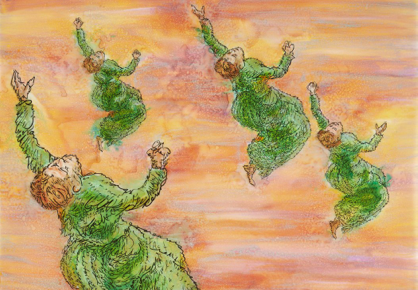
A centerpiece in Waugh’s upcoming exhibition will be an image of a woman in a Victorian-era dress falling, replicated nine times in different sizes, her arms outstretched against an expanse of ethereal brushstrokes in pink, peach, and rose. Three of the figures are blindfolded. Titled The Nine Blasphemies, the image is built from the introduction to A Cyborg Manifesto (1985) by Donna Haraway. Waugh describes it as “a kind of techno utopian text,” dealing with the interface of technology and feminism. He says, “If in the ’80s the idea of canceling somebody had existed, she was ‘canceled’ for this text. The fact that it’s a kind of fraught text is interesting to me.”
Canceling a text is one way of rendering it opaque, but Waugh is also interested in well known texts rendered illegible by commonly held misinterpretations. Waugh started working with Adam Smith’s The Wealth of Nations in 2009. He made 23 drawings and two videos from the text of Smith’s book. Smith’s “invisible hand” metaphor, which proposes that individuals pursuing their own self-interest in a free market unintentionally promote the general welfare of society, is, according to Waugh, “taken out of context in order to justify some bad behavior.”
Waugh’s images seem innocuous at first, but warnings, critiques, and satire aren’t far from the surface. “The current political climate really doesn’t call for being coy,” he says.
The event: A show of works by Michael Waugh and Tess Oldfield
The time: April 17 to 28; opening Friday, April 17, 5 to 8 p.m.
The place: Fine Arts Work Center, 24 Pearl St., Provincetown
The cost: Free
The Nine Blasphemies (#1; Introduction to a Cyborg Manifesto), ink and gouache on Mylar (mounted to Dibond) with pigment overprinting. (Photo courtesy Michael Waugh)
Thursday, April 23, 2026